Crypto casino Brazil: the ranking and what each operator's terms say
Twelve operators ranked by what their own terms and licence registers print: when identity checks start, which amount triggers them, how long you have to send documents, and whether the licence number leads anywhere.
This crypto casino Brazil ranking orders twelve operators by what their own documents say, not by the size of a welcome offer. Each house is scored on five questions about identity checks and the licence, and every fact on the page comes with a clause reference and a reading date.
Under the twelve ranked houses, more Brazil crypto casinos appear as names only, without points.
Five squares, five criteria, in this order: met not met
1the terms carry an identity-check clause
2the clause says at what point the check starts
3the clause prints a money amount
4the terms give a deadline for sending documents
5the issuing authority’s register lists the licence for the operator’s own domain
€1,000 per day · €5,000 per week · €15,000 per monthcl. 11.8
4Metaspins
3/5
Anjouan in the terms, Curaçao in the register
After a trigger eventcl. 9.7
no amount
No cap; instalments possible (cl. 12.5)
5Rainbet
3/5
No licence number published
At withdrawalcl. 20.1
no amount
No cap; $15 minimum (cl. 8.1)
6Shuffle.com
3/5
Curaçao · register: active
After a trigger eventcl. 5.2
no amount
—
7Bitsler
2/5
Curaçao · register: active
After a trigger eventcl. 8.22, 4.3
no amount
Operator sets minimum and maximum (cl. 8.6)
8Thunderpick
2/5
Curaçao · register: active
No moment namedcl. 21.1
no amount
€100,000 per week (cl. 6.12)
9Jack.comformerly Jackbit, renamed 29 May 2026
1/5
Curaçao · register: active
—
—
—
10Wild.io
1/5
Curaçao · holder unclear
—
—
—
11Wolfbet
1/5
Anjouan · number in the terms
No moment namedcl. 5 §1
no amount
$8,000 per week · $30,000 per calendar monthcl. 15 §5
12TrustDiceOwn account of the editorial team
0/5
—
—
—
—
More casinos on the listNo points, outside the ranking
BPBetPanda
TCTG Casino
MDMega Dice
CLCryptoLeo
GGxmble
WWinstler
BBodog
EWExciteWin
PPlayzilla
SCSG Casino
77Bit
222Bet
ICInstant Casino
SSSamba Slots
ISInstaSpin
MBMelBet
GPGolden Panda
LBLucky Block
The ranking. Terms opened on each operator's own pages between 24 August and 12 September 2026; licences looked up in the registers from 8 to 13 September 2026. Each met criterion is one point, five at most (listed above the table); on equal points the order is alphabetical. A filled square means met, an empty one not met. The names under «More casinos on the list» carry no points and no place. Vave sits above the ranking, with no number.
How to read the crypto casino Brazil ranking
The board under this introduction has three layers. On top, Vave carries no rank number and is not scored against anyone.
An editorial illustration, not a screenshot. What decides a place in the ranking is in the operator’s terms, not in its shop window.
Then come the twelve ranked houses, each with five squares, one per criterion. A filled square means the operator's own terms or the licence register answer that question. At the bottom, a card grid lists further operators with no score attached.
In a crypto casino Brazil table built like this one, a dash means no field is on file for that house. It is never a zero, and it is never a hidden advantage either. When a square looks surprising, the methodology explains the rule behind it.
Five questions behind every crypto casino Brazil score
A higher place here means one thing: more of these questions are answered in writing by the operator itself.
The terms contain an identity-verification clause.
The terms say when that check starts: at withdrawal, after a trigger event, or at no named moment.
The terms print an amount that triggers the check.
The terms set a deadline for sending documents.
The licence number resolves, for the operator's own domain, in the issuing authority's register.
In a comparison built this way, bonus size and game counts stay outside the score. Neither tells you when a document will be requested, and neither tells you whether a licence number leads to a real entry. Houses with the same score are ordered alphabetically.
How the reels stop
Three reels stopping one after another. The scene has no payline and no result: it shows the mechanism turning, not the outcome of a round.
The top of the crypto casino Brazil table, house by house
Bitcasino.io takes first place with four squares out of five. Its terms name €2,500 or the crypto equivalent as the amount above which a check can follow (clause 6.6). The Curaçao certificate OGL/2023/111/0069, held by Moon Technologies B.V., showed bitcasino.io in the register lookup of 12 September 2026. What it lacks is a printed deadline for documents.
A crypto cashier as the operator shows it: the coins are named on the deposit screen itself, which is where the list can be checked.
Rocketpot also has four squares. It prints $2,000 in one clause and $2,500 in another (clauses 11.4 and 12.4), and a player asked for papers gets 30 calendar days to provide them under clause 12.2. The fifth square stays empty: the terms quote 1668/JAZ, a number the cert.cga.cw portal returned as not valid in lookups on 12 and 13 September 2026.
Wild Fortune is third, again with four. A trigger event starts its check (clauses 2.7 and 11.2); after a request, the player has two weeks to supply papers (clauses 8.4 and 9.3). The Anjouan licence behind it, number ALSI-202509073-FI2, belongs to Metlait SRL, was issued on 30 September 2025 and carries an expiry of 29 September 2026, a date worth watching.
Metaspins has three squares. The check follows a trigger event (clause 9.7) and documents are due within 30 days (clause 9.10). Its terms print an Anjouan number while the Curaçao register lists Metaspins N.V. under OGL/2024/1063/0437, and those two records have not been reconciled.
Rainbet also scores three. Identity is checked at withdrawal, and clause 20.1 gives 72 hours to respond to a request for documents; that is a deadline for sending papers, not a payout time. Its footer shows no licence number; as the authority, clause 21.6 points to Gaming Services Provider N.V.
Shuffle.com completes the first six with three squares. Its identity check hangs on a trigger event under clause 5.2, and the register showed Natural Nine B.V. with an active certificate, OGL/2024/1337/0628, on 8 September 2026.
The remaining six places:
Bitsler, two squares: an identity clause (8.22 and 4.3) without a named moment; the register lists OGL/2024/930/0387 for Oyine N.V. as active, even though the terms still describe that number as an application.
Thunderpick, two squares: clause 21.1 leaves the moment open; OGL/2024/677/0722 is active according to the register, yet the terms mention no authority and no number.
Jack.com, one square: the former Jackbit, renamed on 29 May 2026, holding a separate active certificate, OGL/2024/1562/1139, granted to Data Link Digital B.V. on 23 July 2025.
Wild.io, one square: two company names disagree, Stack Gaming Ltd in the terms versus Nonce Gaming B.V. on the certificate, and both are left as found.
Wolfbet, one square: an identity clause (5 §1) with no named moment, and Anjouan number ALSI-132405048-FI3 in clause 1 §1 and the footer.
TrustDice, no squares: every cell shows a dash, and the only facts come from the editorial test described below.
Each crypto casino Brazil operator in this table has a dated file in the reviews section.
One spin, several paths
The routes light up one at a time and go out. None of them pays anything here: what the scene shows is that a single spin is read along several paths at once, and that the number of paths is a choice made by whoever programmed the grid — not by the player.
Five criteria, one point each. The bar shows how many of the 12 ranked operators meet the criterion. Terms opened on each operator's own pages between 24 August and 12 September 2026; licences looked up in the registers from 8 to 13 September 2026.
Vave, outside the ranking
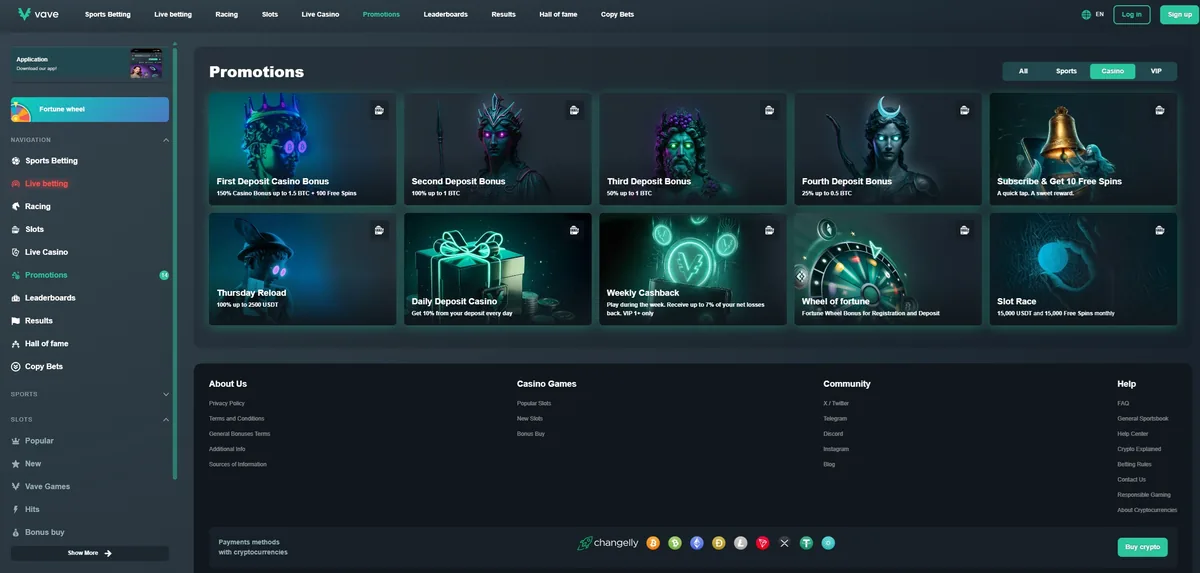
Vave is operated by Latcas B.V. under Curaçao Gaming Authority licence OGL/2024/1676/0905, active since 19 May 2025. When the authority's portal was checked on 12 September 2026, the certificate covered one domain only, vavegame.com, and vave.com did not appear. It stands outside the crypto casino Brazil scores, and its facts follow.
The welcome package is four deposits rather than one: 150%, then 100%, 50% and 25%.
The offer shown on 24 August 2026 gave 150 % on the opening deposit, topped out at 1.5 BTC, and added 100 free spins, followed by 100 %, 50 % and 25 % on deposits two, three and four. That page prints no wagering factor. For anyone weighing a bitcoin casino Brazil welcome offer, that gap is the point to check in the terms.
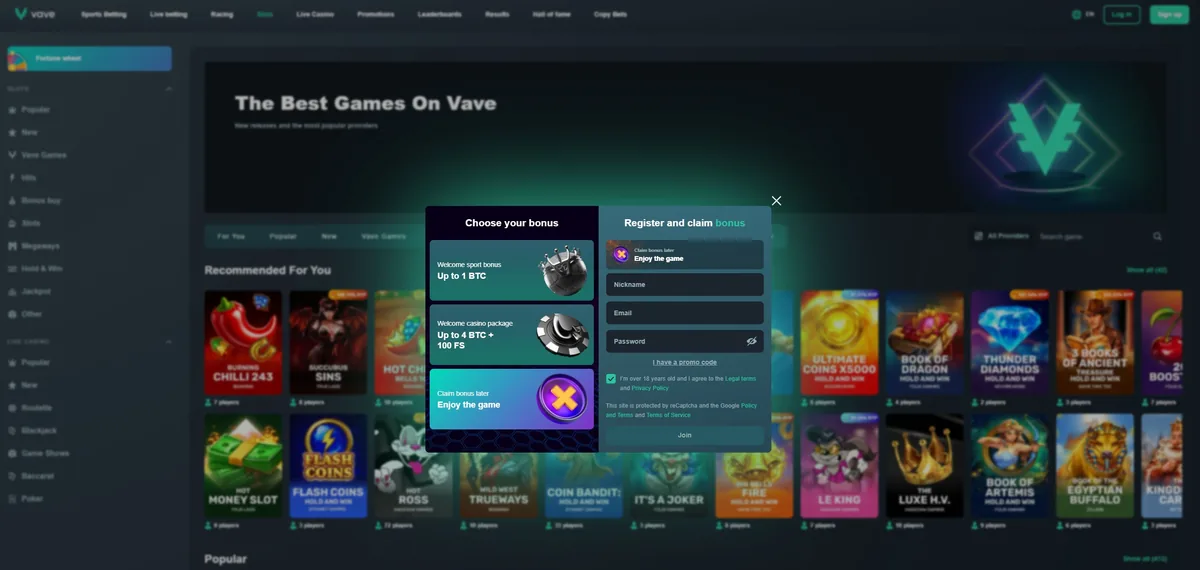
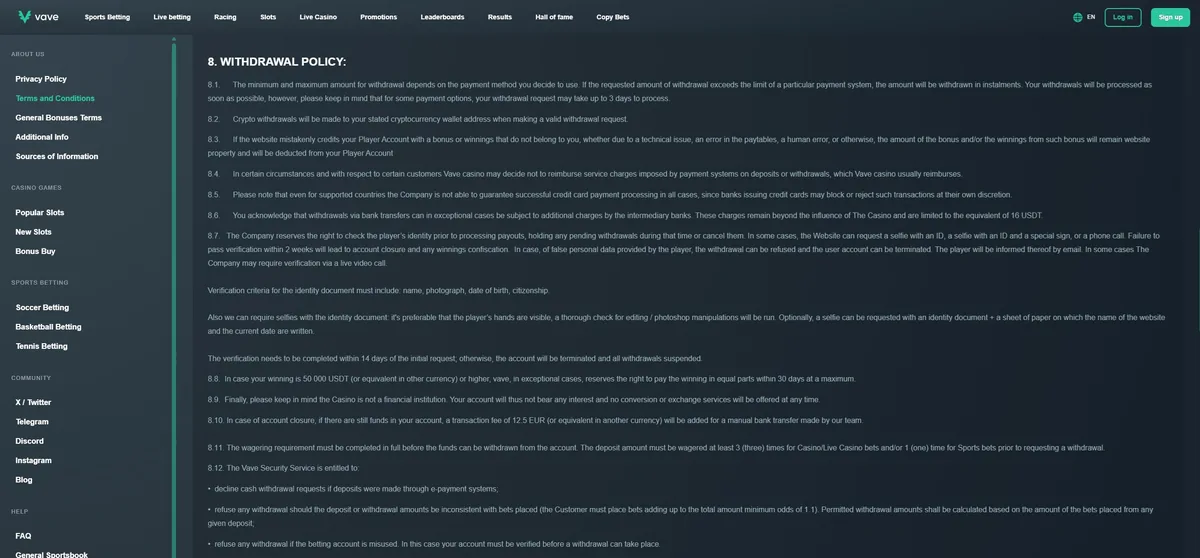
The terms, section 8, were captured on 25 August 2026. Clause 8.7 lets Vave ask for identity before any payout and allows 14 days for the documents. Under clause 8.11, casino and live play must turn the deposit over three times, sports once, before any withdrawal. Clause 8.8 has no period cap; for wins of 50,000 USDT or more it reserves, in exceptional cases, payment in equal instalments. Vave runs a sportsbook as well.
On 28 August 2026 the editorial team ran a real-money test at Vave, depositing and withdrawing its own funds. No ID request came before the cash-outs added up to around 5,000 USDT. One account and one stretch of time make this something seen once, not a promise. Clause 8.7 keeps an identification request open whenever money is paid out.
Two distributions, the same total
Above, a little many times. Below, a lot rarely. The two add up to the same, and that is all the word volatility means. The weights in the first are binomial coefficients from an eight-row grid — 1, 8, 28, 56, 70, 56, 28, 8, 1 — and any reader can recompute them on paper.
What the TrustDice test showed
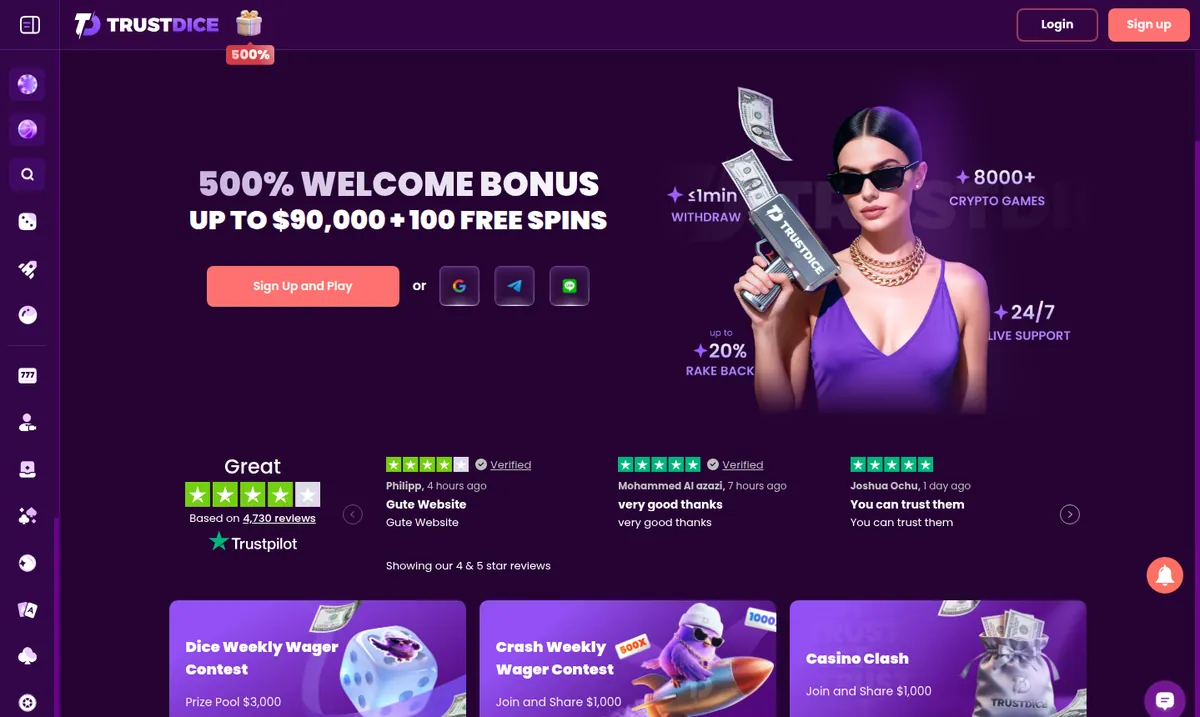
The second real-money test ran at TrustDice in May 2026. The editorial team deposited USDT across several weeks. Cash-outs went through with no document request until their combined value passed roughly US$5,000.
TrustDice is the house of the May 2026 test: the cashier steps described on this page were followed in a real account.
The next request went to “payment under review”. Compliance then wrote, sending a Veriff link. The driving licence submitted was rejected, and the passport was accepted at the fifth try. Some time later a second document request arrived from TrustDice, again by email. The lesson for any crypto casino Brazil player is practical: have a passport ready before the total grows.
The long run
The thin line is the balance across a sequence of bets; the red one is where it tends. It falls because a sum of bets with negative expected value falls, and that holds for any casino game — it does not depend on which house in the table you opened, or which coin you used.
A bitcoin casino Brazil deposit in five steps
Whether you send bitcoin or USDT, the route barely changes, and most mistakes happen at step two.
A first visit opens on the lobby with sign-up on top: email and password. Identity comes later, at the cashier, under clause 8.7.
Open the cashier and pick the coin you actually hold.
Pick the network shown beside that coin and copy the deposit address, plus a memo or tag if the cashier asks for one.
Check the minimum: Rocketpot prints 0.001 BTC (clause 10.2), Wild Fortune 20 EUR (clause 10.4). Wolfbet caps a single deposit at $50,000 (clause 14 §6).
Send from your wallet, paying the network fee in that chain's native coin, and wait for the confirmations the casino requires.
Keep the transaction hash until the balance is credited.
For a first bitcoin casino Brazil deposit, a small test send to the same address costs one extra fee and can save the whole amount. Coin lists and networks at the ranked Brazil crypto casinos are compared in coins and the cashier.
The shape of the check
A list in which one line is stamped and the others are not. The scene shows the shape of the check, not its result: which brand appears on which list is in the table and on each brand's page, with a name and a number, and not in a drawing.
From Pix to a coin
For crypto casino Brazil readers who hold reais, the gap is simple: Pix moves reais, and a crypto cashier works in coins. The usual route passes through an exchange: Pix into the exchange, a purchase of USDT or bitcoin, then a transfer to your own wallet or straight to the casino's deposit address. Whether a given operator offers any other route is for its own cashier page to say. The same path serves a bitcoin casino Brazil deposit or a USDT one. The steps, receipts and the way back are drawn in real, Pix and crypto.
An editorial illustration. From Pix to a wallet and from the wallet to the cashier, every step carries its own fee, and it falls on whoever makes the deposit.
End of the first part
A thick rule cut by the margin marks the end of the first half of the page: from here on come the money route and the check of each operator.
Checks and caps before the first withdrawal
Most Brazil crypto casinos in this table let you sign up with an email and defer the identity check to a withdrawal or a trigger event. The amounts and deadlines each operator prints are set out in identity verification.
Section 8 of the Vave terms: 8.7 on documents before a payout, with 14 days to send them, and 8.8 on sums from 50,000 USDT paid in instalments.
Caps come in different periods and currencies. Wolfbet's clause 15 §5 stops withdrawals at $8,000 a week and $30,000 in a calendar month, Wild Fortune €1,000 per day, €5,000 per 7 days and €15,000 per month (clause 11.8), and Thunderpick €100,000 per week (clause 6.12). Metaspins sets no cap but may pay in instalments (clause 12.5), as does Rocketpot above $5,000 (clause 11.5). The comparison is in withdrawals and limits.
Where an operator publishes a country list, what it says about Brazil is shown on the country-list page. How the Brazilian system relates to foreign-licence operators is covered once, neutrally, in two sets of rules.
Choosing among Brazil crypto casinos: a checklist
Before a first deposit anywhere, run through these points:
An editorial illustration. Gambling is entertainment for adults; the money on the table should be money you can afford to lose.
Copy the licence number from the footer and search it in the issuing authority's register; check the holder, the status and the domains on the certificate. The formats are explained in the foreign licence.
Locate the identity clause; write down any trigger amount and any deadline it sets for papers.
Note the withdrawal cap with its period and currency, and look for an instalment clause.
Read the rollover rule in the terms, not only on the promotions page.
Confirm the coin, network and minimum on the cashier screen.
Write down the date of each reading, because terms change without notice.
The fine print that no cell can hold is gathered in what the table does not say, and the whole routine is in checking it yourself. Among Brazil crypto casinos, the houses that print more of their rules are simply easier to hold to them.
Frequently asked questions
What does a higher place in this crypto casino Brazil ranking mean?
It means the operator's own terms and licence register answer more of the five questions: whether an identity clause exists, when the check begins, which sum sets it off, how long you get to send papers, and whether the licence checks out in the register for the operator's own address. It says nothing about bonus size, game count or how enjoyable the lobby is. Ties are ordered alphabetically, and a dash counts as no answer.
Is Vave ranked first because it pays?
Vave is not ranked at all. It sits above the table, carries no number and receives no score. Its facts are printed like any other operator's: licence OGL/2024/1676/0905 with vavegame.com as the only domain on the certificate, clause 8.7 on documents, and the test of 28 August 2026.
Can I deposit at a bitcoin casino Brazil players compare here without sending documents?
Sign-up often needs only an email, but the identity clauses on file reserve the right to ask for documents, usually at withdrawal or after a trigger event. In the TrustDice test of May 2026 the check arrived once cumulative withdrawals passed about US$5,000. Keep a valid passport and proof of address ready from the start.
Why are withdrawal times not listed?
Because no processing time is given for any operator on this site. What the terms do print are caps per period, instalment rules and deadlines for sending documents, and those are shown with their clauses. How long a transfer takes also depends on the review queue, the documents and the network, none of which a table can promise.
Written and checked by
the cassinocriptobrasil.com desk
Desk
reads operators’ terms and licence registers; tested with its own money only Vave (28 August 2026) and TrustDice (May 2026)